Thursday, 13 October 2016

An acrostic

This is one of my poems, one of a specific kind.

It was a day, such a glorious day!
My heart resonates as a bird.
Along with three mountains under a ray,
Glazed aka nuptial cakes, though blurred.
In dance THEY've merged into a sun:
Never you've seen this before!
Insistent shouts vibrating like one...
Narcissus'd forgotten his sour!
Graceful and rhythmic, THEY are calm as machine.
Dawning has coloured the mill...
Rigid of lines underlined mise-en-scène:
Aurora scattered sweet chill.
Grateful I feel to have seen such a scene.
Only one thought can abruptly distract:
Nothing is real but nothing is dream...
Set as alive as a bookish extract.


The poem is well-protected and must not be copied neither used without my name included as its author and my permission to post it. Thank you!


Acrostic is a versed composition in which you can find a specific set of letters or words to compose a word or a phrase. It helps, for example, to encrypt the true meaning of the text or create a pattern. An acrostic can be a puzzle and/or a joke in order to create a specific mood and then change it as the enigma is solved.
Acrostic was invented ages ago by Ἐπίχαρμος (Epicharmus Comicus). It was also used as a good protection of author rights, for instance, Quintus Ennius used the technique to spell his name out and confirm that he is indeed the author (Fisher, J., 2014, p.84 - The Annals of Quintus Ennius and the Italic Tradition). 

It is interesting that a poem, which is considered as a phonetic kind of art can also be visual as one often has to see the poem so she/he can understand the trick. It even leads us to the ancient illuminated manuscripts, which initials were carefully drawn. This sense of beauty appears in acrostics, especially alphabetical, too as they maintain a preassigned rhythm. When they are read, they might lost it but not when their main idea is to confuse the reader - in this case they would surprise him/her in the end as they will have a look at it.

Gears

I love to learn something new and when I decided that my next Photoshop project would be gears, I began to read and watch material of how they are made and how they work.
Thus I have begun to calculate and end up with a special chain. I learn a lot about gears though the whole work!
A video was a result of it and a gif, which you, my dear reader, can find below, is merely an example. The video is longer than the 5 sec. gif, and, obviously, is distinguished by a better quality. All gears were made separately, drawn by me, their resolutions are, on average, 1000 pixels.


As you, dear reader, can see, several gears are rotating with a different speed rather than others. They also create a special pattern and every one of them is important.
The gear on the right was influenced by madhatter's lesson (from the site http://steampunker.ru/) steampunk gear, although I made it thicker and the teeth longer, while the inner side are halfs of four triangles.

My friend Simon. A poem.

I think one of the best way to learn something is joking - in it, summarizing it, or even before starting the topic. It is indeed a method making it easier to memorise something as it evokes emotions - positive emotions...


I have a friend with whom I talk.
He helps with plots to splice.
Despite he likes the prose to chalk,
This joke is his advice.
He always smiles, so does he now -
Infective this, presume -
And always knows the best way how
To hide a witchcraft broom.
In languages he is well versed,
And thinks no pause is dull.
Guess, I had to say at first,
That Simon is a skull?

Anna Kavan, 2016.

The poem is well-protected and must not be copied neither used without my name included as its author and my permission to post it. Thank you!


So what is a joke? It is a ruining of your expectations. It is a surprise and that's why most jokes are not seemed as funny as they were when you heard them first time. The presented poem is a double entendre (sort of), as it suggests two meanings at the beginning: one may imagine a human or an imaginary friend at least, but ending with a punch line, crossing out other images. 

It can be also considered as dark humour, but is it for real? What is dark humour at all? I wrote an essay on this topic and it seems to be many things. Can one place this poem on a dark humour shelf only because of the "skull" word application or because the reader may imagine a skull made of organic material of, for example, 22 or less bones? In the matter of perspective and only it, I will give you, if you will allow me to, some extra information which might change the poem "shelf". Ready? Simon is a plaster model of a skull. So can it be considered as a dark humour example only because of the image it makes?

Forgotten. My short film.

I have done a lot of work to create this project and although I can see which bits I can improve to make the story even better, I am still proud of it. I wrote the script for it, draw a storyboard, did the camerawork and directing, designed and etc.
Two "films" are combined into one: the story itself is accompanied by a stop-motion part. I made this decision as stop-motion can remind the audience about paintings and awoke a feeling that everything in it is an illusion or a memory.

Cinematographic logline: Something out of their expectations.

The premise: A drama with gothic elements, telling about two scientists who become extremely interested in a story of an artist living ages ago. As her paintings have disappeared with her, nobody can touch or even get to know her art closer… or can? Is there still any purpose in it if it feels like it has never existed? Can science and art understand each other? The characters of this story try to answer these questions.


The audience watches the film within a certain perspective, point of view (POV). The way it sees it is a decision made by the filmmaker, who wants to tell the story. Forgotten tells the story from two points of views: from the perspective of Matthew and Piter as the audience should experience the same artistic awake they do, and from the perspective of something as powerful as Time. The audience has more information rather than the two present characters: it knows how Lily looks like, it knows that she was called a witch and therefore has some thoughts about the reason she died (maybe she was killed and the fire was neither a mistake nor accident but a directed murder committed by the people afraid of her), it sees that Piter sits on the same tree Lily sat before… At the same time the audience watches through Piter’s eyes as it:
- Cannot see anything on the wall when Matthew can.
- Sees paintings simultaneously with Piter in the end.
- Can hear Piter’s voice over aka his thoughts.
Therefore, the storytelling mode of narrative can be considered as the first person one, at the same time there is a third person mode of narrative, appearing with memories of Lily, quite subjective and placed behind the curtain. Who does watch Lily when she is in her house or outside of it? Who does see her drawing or is it her POV? Then who receives her memories? Has they been collected somewhere and being hold in a bottle to be splashed on the audience when they hear her story to make assumptions on what has happened years ago? There is a film called The Book Thief (2013, directed by Brian Percival), which has a voice representing Death, who watches at people from above and chooses people to follow. And Forgotten has a similar sense of someone following the characters, listening to them.
The story information received by the audience is given in portions and doses. In the beginning the topic is established, but rather slowly. The main idea was to surround the audience with small stylistic decorations to pour on its head the final information about the story purpose when the audience is ready and swims in the right atmosphere. This atmosphere is composed from specific sets:
- Nature, the establishing shot.
- Wall and stone, focusing on the discussion object.
- Matthew and Piter representing present.
- Shots of Lily presenting a gothic style.
- Shots of drawing and paint to add the artistic atmosphere.
- Shots of red paint to add some anxiety.
- Ballet shots and books’ pages shots to open Lily’s character more, showing her interests.

Forgotten can also be divided into three acts:
1. Introducing the main characters with the voice over.
Creative the necessary environment with the establishing shot of the field.
The discussion of the problem the main characters have.
And introducing their relationship via the use of phrases like “I don’t know why you’ve taken me here” showing they know each other for a long time. 
2. The confrontation crisis is the split between the characters when Piter decides to think over the problem on his own (Voice-over part).
The shots also give more information about the artist.
It results into the crescendo with the poem scene when all information is given.
3. The resolution is the summing up all thoughts the characters have.
But moreover they are going to have a “gift of the Magi” for this – the opportunity to see the ghost paintings. 
Returning to the point of time, place, and action. Although the place remains the same – the ruins or the house as it was ages ago, the time changes. The storyline begins with the present, now (early evening), in the ruins in the middle of nowhere to create a sense that it can happen anywhere.
Memories interrupt the narrative several times as they are too powerful for the present: one cannot stand but has to return to the times when Lily was alive, let’s call it the energy of the past. And because this place, this wall, and these ruins are full of this energy as she lived and created her pictures there, this energy is awaken and tries to get between the shots, between the dialogue’s parts.


Wednesday, 12 October 2016

In the woods.

Again, one of the poems of mine.
I wanted to maintain a Gothic atmosphere similar to some old fairy tales I read as a child.
I want to collect them in my hand, hinting at some psychological aspects of the tales, which do relate to the modern life, and show them to the reader. I hope I succeeded.


I beg you, my darling, don't cry - it will pass.
Don't follow your friend, cut your feet in the grass.
I promise to look back on the margin at last
Afore the first step to the woods.

The wind takes my hand, it pushes me inside;
Soon I'll be left with no friends on my side.
The first has her way, while wind cannot hide
Amidst curvy trees in green hoods.

The first step is not always the worst step at all.
Apparently it's just a response to the call.
Light as it is, it warns you will crawl,
Leaving a track in the woods.

To get more complicated and wavy it tends -
A frightful sign pointing at several ends.
But having a hope to greet both of my friends
I dream to emerge from the woods.


Anna Kavan, 2016.

The poem is well-protected and must not be copied neither used without my name included as the author and my permission to post it. Thank you!

1066. Battle of Hastings. My small poem.

The ray would toucheth again
Some sprinkl'd moss.
Survive, be brave, my thegn,
It comes, it's full of fuss.
1066. The end began.

The poem is well-protected and must not be copied neither used without my name included as its author and my permission to post it. Thank you!

It is not my opinion about the war.

Sunday, 2 October 2016

One day I was a wandering bird...

One day I was a wandering bird
On an alder tree.
It was warm.
The figure was blurred,
But I believe in the sea
Someone was fighting the storm.

One man had no chance,
Had not flied away.
In panic I was looking for hand.
Just one little glance:
Here's a couple that stay
How lucky! - still on the land...

One day I was a wandering bird.
It was sunny,
I wanted to sing.
But I'm still trying to say a word
Through a glory
Ray in the spring.

Anna Kavan, 2015.


The poem is well-protected and must not be copied neither used without my name included as its author and my permission to post it. Thank you!

Monday, 20 May 2013

Portsmouth and Isle of Wight

Some of my photos. Actually, there are about 600 of them, so I was checking them for, I dunno, a couple of hours - in the result it was not very long! I didn't use Photoshop, the photos are fresh and crispy and have just come from the camera. They are calm and peaceful. Well, you know my style: I love to film nature and little things which surround us. Do you actually notice them? Last time I was walking near the Queens park in Brighton - and guess what I found! V, painted right on a box with something. Or have you ever seen a hungry seagull, which is looking what to sneak and moving its head in such a funny way, like justifying it's innocence.
That day I had got plenty of time. Just a few people were walking outside - Isle of Wight isn't a warm place, also it was a bit windy. So in the beginning it was very-very-very boring. Hopefully I had got a camera with myself, so I was trying to catch a good view with my sharp-sighted eyes. Honestly, I practice the spontaneous shooting, but that time was fascinating. Because I wasn't within the framework of time I could move slowly, looking for a picture - but not for a photo. I was trying to find a view, which reminds the audience about paintings. So do you like watercolours?


Portsmouth and Isle of Wight


Tuesday, 2 April 2013

Narcissus.

And Echo was asking "who’s there, who's there"...
I don't like yellow. Seriously.  Not the best beginning, is it? But I love flowers. Narcissuses have got a special aroma, and because of it they looks like little suns, but not as simple yellow flowers. They are proud and lordly creatures. And they look very adorable in the green, sitting together in groups. Their little heads with crowns droop in various sides - are they talking? Or, maybe, they are discussing how forest fairies danced under them in the night? Walking under the suns and the Moon. What can be more magical?


And spring.


Monday, 25 March 2013

Brighton.

A little trip to Brighton cannot be good without my camera.
I love to walk in this little city. It's very different from other English towns, with its Pier, birds, sea. Every time you're in it, you're waiting for a fair or a bright event, which will blow the day up and change everything. This city is a little surprise, every time making you rack your brain what you'll see after the next turn. You are going in the centre of the crowd - and everything is moving so fast, that you can't realise where are you, on which planet, but you are making several steps - and you see little houses in calm and peaceful world. Silence and apian noise, pacification and laugh - how this little town can succesfully combine these antipods? Suppose, that is because of the students - oh, we know how to make the world going round! Two big Universities keeping under their wings many different minds, who fill up with their freedom all these streets. Near Churchill square live music is played, the Pier is full of shops and the waves making the best background on the Earth.


Archery.

Archery. For me it's not just a kind of sport, one of the list. It's a special moment, when you take long, light arrow and release it in the air. One second - and it is already in the target. One second for the all audience - an eternity for the archer. You are staying in the right position, breathing before diving into an adventure, holding an elegant and graceful bow, looking in the middle of the round, in the gold, thinking, calculating the best point, which will be aimed. You're remembering geometry, trying to be cunning, trying to be strong... And you'll miss it. You will miss this little piece of wood, which was in you hands just a second ago, you're becoming an audience. You're looking at the target and notice that the arrow doesn't hit the gold. You're asking: "Why?" The answer is simple. The perfect archer always feel his bow and arrow. He doesn't stay in the right position - he feels comfortable. He doesn't hold the arrow - he supports it. He doesn't calculate - he knows where to shoot. Only when you will learn that bow and arrow are your friends - you'll hit the gold. Over and over again. Without any help. Just because you're working together, supporting, feeling, being a part of each their. That's the reason why I love archery - it reminds me about how we're living. Like little islands, near but so far at the same time from the whole world, playing your own music, dance your own dance, letting your arrow go. You're staying with the bow - you're alone, but after you have release the arrow - you are coming back to the world. And understand, that even if you make a mistake, you will always have a chance to try again. And to become perfect.


Monday, 11 February 2013

Le ballon rouge.

 "Tu deviens responsable pour toujours de ce que tu as apprivoisé".
"You become responsible forever for what you’ve tamed".
Antoine de Saint-Exupéry, The Little Prince


I love short films. When you haven't got a lot of time, you're trying to put everything in these 2-10-30 minutes, all your thoughts, all you soul. Short films have something special inside, they remind me little children, open and naive, who only going to be adults, but already very smart. Furthermore, I adore French cinema, so The Red Balloon is one of my favourites. Made in 1956, this film is full of metaphors and ideas, it shows us that the friendship is one of the most powerful things in the world and that it's very difficult for uniques to live here.
The red balloon is flying during the whole film like a symbol of this friendship. The viewer sees it immediately on the screen - it attracts attention. It reminds me the girl in the red dress in Schindler's List - the same naive symbol of peace, which is killed by grey mass.
The film is not very bright - it's made to show the colour of the balloon. Many views of the sky signifies freedom, streets and windows show the new life. The boy was going to school every day, but the day with his friend is special so the viewer watches the walk in details. The camera moving smoothly, it follows the boy and the balloon, tanning (as at 3.34) is used as well.
French streets, atmosphere, sounds and a big red balloon - every detail shows us the beauty, the life and the love.


Take care of your friends.


Monday, 4 February 2013

Paperman.

- I'm not a puppet, I'm a real boy!
- Five shillings for the possessed toy. Take it away.
Shrek.
 
 
Paperman.
A film by Disney.


Honestly, I don't like most of the Disney movies (except of Mulan, Lilo and Stitch, Bambi, Hercules (only because of Hades) and Lion King). They are too sweet for me. Furthermore, if Disney takes an idea from a book it will always change it (The Hunchback of Notre Dame, The Little Mermaid). And its main heros are always beautiful, while the evils are ugly.
But I'm talking about Paperman.
Have you watched it? Did you feel déjà vu? I have and I did.
And I don't talk about the pictures.
I'm talking about the main atmosphere.
 
 
Do you know this film? The Fantastic Flying Books of Mr. Morris Lessmore. It's an amazing one.
If you watch both you'll feel that they are quite similar - the atmosphere. How the books are papers are dancing and the metaphore.
But The Fantastic Flying Books of Mr. Morris Lessmore was born in 2011, whereas Paperman is a 2012 movie. You can say that Paperman is different, but in fact it's copied. Copied Pixar, The Fantastic Flying Books and Disney's films as well. The animation is Disney's (a strong déjà vu - the faces of the main heros reminds me other Disney's movies), but this attempt to make a film with a Big Idea... Remember the Pixar's films - all of them full of great ideas, they are independent. But Paperman has got only a Love Idea, which can be good if there wasn't one thing. I'm not a cynic, but I don't like when Boss is represented as the main evil and the papers are throwing out from the window. Of course, we understand "the metaphore" that the main character wants to go out from this boring building, go to his beloved, but this film doesn't show us this idea as Pixar or The Fantastic Flying Books do.
To sum up, Disney watched a lot of Pixar's films and wanted to make its own clever film. But the attempt was weak. The same character, the same movements, but copied ideas (they couldn't even copy them in right way).

Monday, 28 January 2013

Dr. Jekyll and Mr. Hyde (1920).

It chanced on one of these rambles that their way led them
down a by-street in a busy quarter of London...

Strange Case of Dr. Jekyll and Mr. Hyde
by Robert Louis Stevenson


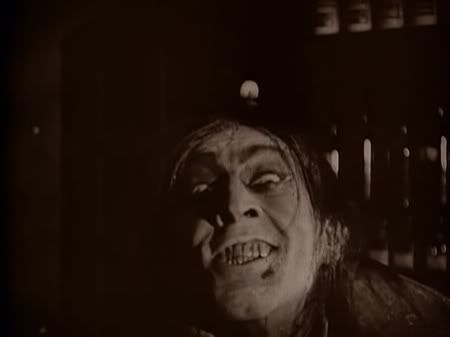
The film is brilliant. Why film directors from the past are so gentle and attentive with books' screen versions? Even Dracula by Tod Browning with wrong relationships between characters and absent pieces is full of "the book" more than Dracula by Francis Ford Coppola. But I'm not speaking about the book b B.Stoker, although I want to. I'm speaking about Dr. Jekyll and Mr. Hyde, which is a 1920 horror silent film, based on Robert Louis Stevenson's novella The Strange Case of Dr. Jekyll and Mr. Hyde. Both Dr. Jekyll and Mr. Hyde were played by John Barrymore. The film was directed by John S. Robertson.
I didn't find many different kinds of angles or camera high and this makes the film a bit theatrical. But the characters are always in focus and in the centre of the picture, except of this moment:
 

Definitely POV of Mr. Hyde's victim. The director is still using eye-level angle shot, but the face of the main character is below.


P.S. to be continued.


Wednesday, 23 January 2013

Dirty Harry.

Whatever happens, we have got
The Maxim gun, and they have not.
Hilaire Belloc


Dirty Harry is an American film by Don Siegel. It's the first part in the Dirty Harry series and one of the best film for ever. The film is about a police officer, who is using dirty methods to protect people from violence. One of the most interesting things is that all his partners keep getting injured or even killed. There isn't any official explanation why everybody call Inspector Harry Callahan "Dirty Harry", but Frank DiGiorgio says that Harry "hates everybody: Limeys, Micks, Hebes, Fat Dagos, Niggers, Honkies, Chinks, you name it" and Callahan says that he is doing "every dirty job that comes along".
 

I know what you’re thinking: "Did he fire six shots, or only five?" Well, to tell you the truth, in all this excitement, I’ve kinda lost track myself. But being this is a .44 Magnum, the most powerful handgun in the world, and would blow your head clean off, you’ve got to ask yourself one question: "Do I feel lucky?" Well do ya, punk?


The film is rich with using different types of angles and one of the most famous scenes in this film, when Inspector Callahan is standing on Scorpio's wounded leg, camera is going away, higher and higher, and we still can see them, but they are getting smaller and smaller.
Another famous scene, when Harry Callahan is saying his famous speach, which is stated above, is using two different types of angles to show us different points of robber's and his views. The robber is laying on the ground, but Inspector Callahan is standing near him and watching at him from above. So the first angle is worm's eye one and the second one is high angle. Furthermore the director is using XCU (Extreme close up) when the camera is showing the robber's hand near the gun.
These are two most famous scenes. Clint Eastwood is very good as always and if you used to see him only in western films, you should see Dirty Harry - it's not the same.


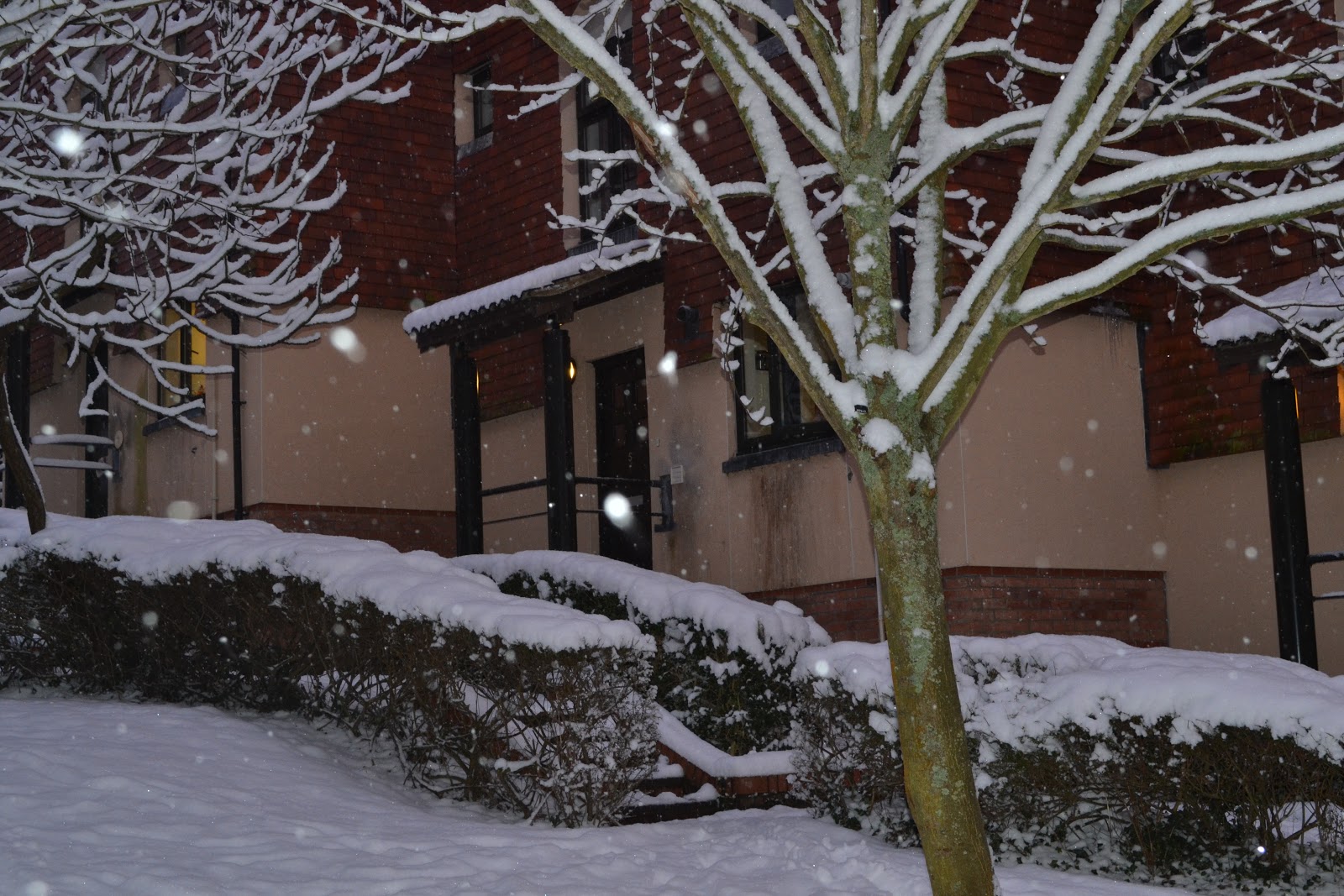
Winter photos.

Enjoy some winter pictures, which were taken these days.