Monday, 11 February 2013

Le ballon rouge.

 "Tu deviens responsable pour toujours de ce que tu as apprivoisé".
"You become responsible forever for what you’ve tamed".
Antoine de Saint-Exupéry, The Little Prince


I love short films. When you haven't got a lot of time, you're trying to put everything in these 2-10-30 minutes, all your thoughts, all you soul. Short films have something special inside, they remind me little children, open and naive, who only going to be adults, but already very smart. Furthermore, I adore French cinema, so The Red Balloon is one of my favourites. Made in 1956, this film is full of metaphors and ideas, it shows us that the friendship is one of the most powerful things in the world and that it's very difficult for uniques to live here.
The red balloon is flying during the whole film like a symbol of this friendship. The viewer sees it immediately on the screen - it attracts attention. It reminds me the girl in the red dress in Schindler's List - the same naive symbol of peace, which is killed by grey mass.
The film is not very bright - it's made to show the colour of the balloon. Many views of the sky signifies freedom, streets and windows show the new life. The boy was going to school every day, but the day with his friend is special so the viewer watches the walk in details. The camera moving smoothly, it follows the boy and the balloon, tanning (as at 3.34) is used as well.
French streets, atmosphere, sounds and a big red balloon - every detail shows us the beauty, the life and the love.


Take care of your friends.


Monday, 4 February 2013

Paperman.

- I'm not a puppet, I'm a real boy!
- Five shillings for the possessed toy. Take it away.
Shrek.
 
 
Paperman.
A film by Disney.


Honestly, I don't like most of the Disney movies (except of Mulan, Lilo and Stitch, Bambi, Hercules (only because of Hades) and Lion King). They are too sweet for me. Furthermore, if Disney takes an idea from a book it will always change it (The Hunchback of Notre Dame, The Little Mermaid). And its main heros are always beautiful, while the evils are ugly.
But I'm talking about Paperman.
Have you watched it? Did you feel déjà vu? I have and I did.
And I don't talk about the pictures.
I'm talking about the main atmosphere.
 
 
Do you know this film? The Fantastic Flying Books of Mr. Morris Lessmore. It's an amazing one.
If you watch both you'll feel that they are quite similar - the atmosphere. How the books are papers are dancing and the metaphore.
But The Fantastic Flying Books of Mr. Morris Lessmore was born in 2011, whereas Paperman is a 2012 movie. You can say that Paperman is different, but in fact it's copied. Copied Pixar, The Fantastic Flying Books and Disney's films as well. The animation is Disney's (a strong déjà vu - the faces of the main heros reminds me other Disney's movies), but this attempt to make a film with a Big Idea... Remember the Pixar's films - all of them full of great ideas, they are independent. But Paperman has got only a Love Idea, which can be good if there wasn't one thing. I'm not a cynic, but I don't like when Boss is represented as the main evil and the papers are throwing out from the window. Of course, we understand "the metaphore" that the main character wants to go out from this boring building, go to his beloved, but this film doesn't show us this idea as Pixar or The Fantastic Flying Books do.
To sum up, Disney watched a lot of Pixar's films and wanted to make its own clever film. But the attempt was weak. The same character, the same movements, but copied ideas (they couldn't even copy them in right way).

Monday, 28 January 2013

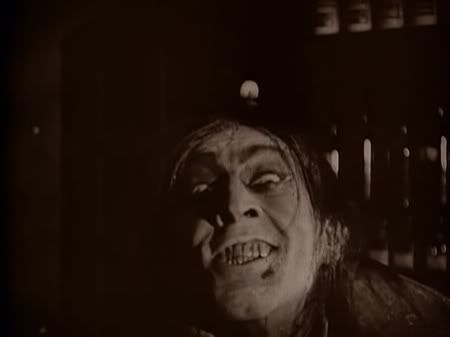
Dr. Jekyll and Mr. Hyde (1920).

It chanced on one of these rambles that their way led them
down a by-street in a busy quarter of London...

Strange Case of Dr. Jekyll and Mr. Hyde
by Robert Louis Stevenson


The film is brilliant. Why film directors from the past are so gentle and attentive with books' screen versions? Even Dracula by Tod Browning with wrong relationships between characters and absent pieces is full of "the book" more than Dracula by Francis Ford Coppola. But I'm not speaking about the book b B.Stoker, although I want to. I'm speaking about Dr. Jekyll and Mr. Hyde, which is a 1920 horror silent film, based on Robert Louis Stevenson's novella The Strange Case of Dr. Jekyll and Mr. Hyde. Both Dr. Jekyll and Mr. Hyde were played by John Barrymore. The film was directed by John S. Robertson.
I didn't find many different kinds of angles or camera high and this makes the film a bit theatrical. But the characters are always in focus and in the centre of the picture, except of this moment:
 

Definitely POV of Mr. Hyde's victim. The director is still using eye-level angle shot, but the face of the main character is below.


P.S. to be continued.


Wednesday, 23 January 2013

Dirty Harry.

Whatever happens, we have got
The Maxim gun, and they have not.
Hilaire Belloc


Dirty Harry is an American film by Don Siegel. It's the first part in the Dirty Harry series and one of the best film for ever. The film is about a police officer, who is using dirty methods to protect people from violence. One of the most interesting things is that all his partners keep getting injured or even killed. There isn't any official explanation why everybody call Inspector Harry Callahan "Dirty Harry", but Frank DiGiorgio says that Harry "hates everybody: Limeys, Micks, Hebes, Fat Dagos, Niggers, Honkies, Chinks, you name it" and Callahan says that he is doing "every dirty job that comes along".
 

I know what you’re thinking: "Did he fire six shots, or only five?" Well, to tell you the truth, in all this excitement, I’ve kinda lost track myself. But being this is a .44 Magnum, the most powerful handgun in the world, and would blow your head clean off, you’ve got to ask yourself one question: "Do I feel lucky?" Well do ya, punk?


The film is rich with using different types of angles and one of the most famous scenes in this film, when Inspector Callahan is standing on Scorpio's wounded leg, camera is going away, higher and higher, and we still can see them, but they are getting smaller and smaller.
Another famous scene, when Harry Callahan is saying his famous speach, which is stated above, is using two different types of angles to show us different points of robber's and his views. The robber is laying on the ground, but Inspector Callahan is standing near him and watching at him from above. So the first angle is worm's eye one and the second one is high angle. Furthermore the director is using XCU (Extreme close up) when the camera is showing the robber's hand near the gun.
These are two most famous scenes. Clint Eastwood is very good as always and if you used to see him only in western films, you should see Dirty Harry - it's not the same.


Winter photos.

Enjoy some winter pictures, which were taken these days.


Shot sizes.

Let's have a look at shot sizes that are very widespread in the media.


XLS


LS


MLS


MS


MCU


CU


 BCU


XCU


I am Cuba (1964)

Because none of us are as powerful as all of us.


The clip is black and white, begins with a representing of a shouting crowd and a girl and than a man who are going through it. Camera is using MS (Medium shot) and High level. At 0.14 the angle is changing to canted, but steel high. From 0.20 the camera is using MCU (Medium close up), but than again returns to MS. From 0.36 the camera is shooting with canted angle, which signified that the man is doing a mad thing - he is going to the police, holding a stone in the right hand. At 0.50 he is starting to go through smoke, and we thinks that he has dissapeared, but he appears again in 3 sec. Now the camera is using MLS (Medium long shot) to help us to see the stone and still keeping canted angle. From 1.12 we can see the man in LS (Large shot), but still with a high canted angle. He is passing a burning car and we can see the battle of water and fire. Water trying to stop the man, but he is going. From 1.30 we see MS but an eye-level angle shot, which transforms into canted angle, what makes the police, represented in it, bigger than the man. There are many contrast: fire and water, stone and pistol, a group of people and one man, high angle and eye-level one. After this we see the man in a LS shot high canted angle . He has got a shot by a pistol and the camera is sharply moving to repeat his movement, which signified his pain. The man is continue moving, but without the stone and very slowly. At 2.16 the camera is changed and we see MCU shot low canted angle. Furthermore it looks like the lens on the camera are uneven, because the man's face begins to transform like in a false mirror. The man falls and the camera whirls. We see some humans figures in LS shot eye-level canted angle. Everything dissapears.